 MyHomeDoc
Work and School Accommodation Letters
Learn how to get a medical accommodation letter in Texas for work or school. MyHomeDoc offers online doctor evaluations for ADA & 504 accommodation requests.
A health condition can affect how you work, learn, concentrate, communicate, travel, sit, stand, or manage a schedule. In many situations, a workplace or school may ask for a physician statement that explains why an accommodation is medically appropriate. MyHomeDoc Telehealth helps eligible patients in Texas obtain individualized medical evaluations and, when clinically supported, physician accommodation letters or completed forms for work or school.
What is an accommodation letter
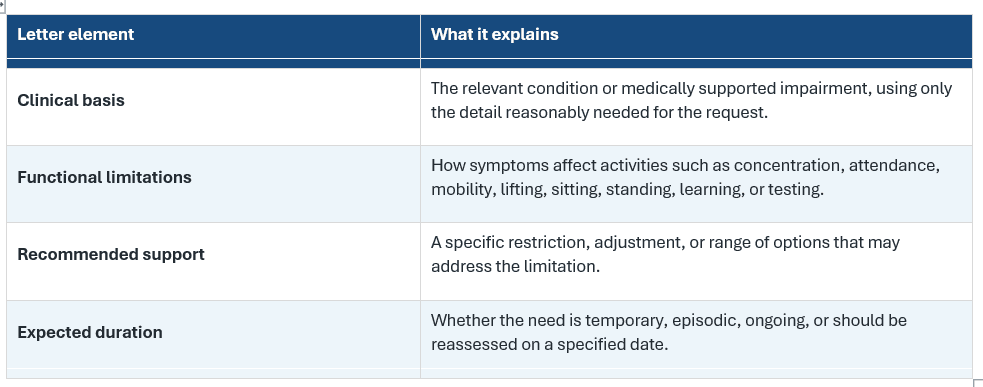
An accommodation letter is medical documentation written by a licensed healthcare professional. It connects a diagnosed or evaluated health condition to specific functional limitations and explains what changes may help the patient perform essential job duties or access education. The letter does not automatically approve an accommodation. Employers, schools, disability services offices, and testing organizations review the documentation and make the final decision under their own policies and applicable law.
A well-written letter generally focuses on function rather than sharing an entire medical history. Depending on the request, it may describe the expected duration of limitations, recommended restrictions, and accommodations that could reduce symptoms or provide equal access.

Examples of workplace accommodations
Work accommodations vary by the person, the medical need, and the essential duties of the position. Examples may include:
•A modified start time, flexible schedule, or additional breaks
•Temporary remote work or a hybrid schedule when job duties allow
•Limits on lifting, prolonged standing, repetitive movement, driving, or overnight travel
•An ergonomic workstation, supportive seating, or assistive equipment
•Time away for medical appointments, treatment, or symptom flare-ups
•A quieter workspace, reduced distractions, or written instructions
•Access to food, water, medication, a restroom, or a private space for health needs
•A temporary reduction or modification of nonessential tasks
Under the federal Americans with Disabilities Act, covered employers generally must consider reasonable accommodations for qualified applicants and employees with disabilities unless the accommodation would create an undue hardship. A request can begin in plain language; however, an employer may request limited medical documentation when the disability or the need for accommodation is not obvious. Other laws or workplace policies may also apply.

Examples of school accommodations
Medical documentation may support accommodations in elementary school, high school, college, graduate school, vocational programs, or qualifying examinations. Possible accommodations include:
•Extra time or a reduced-distraction room for tests
•Rest breaks during class, testing, or clinical activities
•Flexible attendance or deadline consideration during documented symptom episodes
•Permission to record lectures or receive notes in an accessible format
•Preferential seating or access to an elevator
•Modified physical activity, mobility support, or limits on prolonged standing
•Access to medication, food, water, restrooms, or a private health space
•A reduced course load or temporary academic adjustment when medically appropriate
Requirements differ by setting. Public elementary and secondary schools may evaluate students under Section 504 and, when applicable, the Individuals with Disabilities Education Act. Colleges and universities usually require students to identify themselves to the disability services office and follow the institution's documentation process. A prior IEP or 504 plan may be useful but may not, by itself, satisfy a college's current documentation requirements.
What a physician statement may include
How MyHomeDoc Telehealth can help
MyHomeDoc offers convenient online medical appointments for patients located in Texas. During the visit, a physician can review your health history, current symptoms, medications, job or academic demands, and the accommodation you are requesting. When the available clinical information supports the request, the physician may prepare a statement or complete appropriate employer or school paperwork.
What to have ready for your appointment
•The accommodation form, documentation guidelines, or instructions from HR, your supervisor, the school, or disability services
•A clear description of the essential job duties or academic activities affected
•Relevant medical records, diagnostic reports, treatment history, and medication list
•The accommodations you are requesting and how they would help you work or learn
•Any deadline, return address, fax number, or secure submission instructions
Not every request can be certified during a single telehealth visit. Additional records, an in-person examination, testing, specialist input, or follow-up may be required. MyHomeDoc cannot guarantee that a physician will recommend a particular accommodation or that an employer, school, or testing organization will approve it. Letters are based on independent medical judgment and the information reasonably available to the clinician.
Frequently asked questions
Do I have to disclose my full diagnosis?
Often, documentation can focus on the relevant impairment and functional limitations. The exact information required depends on the setting and the request. Employers generally should not seek unrelated medical records as part of an ADA accommodation review.
Can a letter recommend remote work or flexible attendance?
Yes, when clinically appropriate, a physician may explain why a schedule change, remote arrangement, or attendance flexibility could address a functional limitation. The organization decides whether that option is reasonable and whether another effective accommodation is available.
Can MyHomeDoc complete my organization's form?
Potentially. Upload or provide the form and instructions before the appointment whenever possible. The physician must first evaluate the request and may need supporting records or additional information.
Can a physician write a certified accommodation letter?
Yes, a MyHomeDoc Telehealth physician can write a certified accommodation letter, after a medical evaluation is done.
Is an accommodation letter the same as FMLA or disability paperwork?
No. ADA or school accommodation documentation serves a different purpose from FMLA certification, short-term disability claims, workers' compensation, or a fitness-for-duty examination. Tell the physician exactly which form or process you are using.
Book an affordable online appointment
Need a physician accommodation letter for work or school?
MyHomeDoc Telehealth provides affordable online medical visits for patients in Texas, including patients without insurance. Appointment available for a medical paperwork visit at MyHomeDoc. Book online at www.myhomedoc.care to discuss your medical needs and requested accommodations with a physician.
This article is for general educational purposes and is not legal advice. Accommodation eligibility and documentation requirements vary by employer, school, program, and individual circumstances. A telehealth visit does not guarantee a letter, form completion, or approval.
Sources and further reading
•U.S. Equal Employment Opportunity Commission. The ADA: Your Responsibilities as an Employer. eeoc.gov
•U.S. Equal Employment Opportunity Commission. The ADA: Your Employment Rights as an Individual With a Disability. eeoc.gov
•U.S. Department of Education, Office for Civil Rights. Section 504 and disability discrimination resources. ed.gov
•U.S. Department of Education. Students with Disabilities Preparing for Postsecondary Education. ed.gov
•Job Accommodation Network. Requests for Medical Documentation and the ADA. askjan.org
Have questions? Talk to a doctor today.
MyHomeDoc physicians are available 7 days a week across Texas.
Book an Appointment